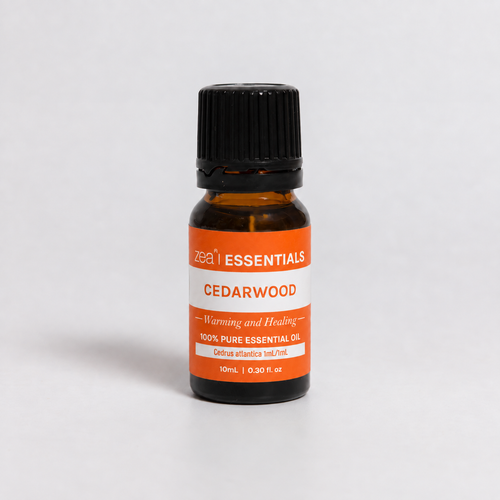
Cedar oil, cedarwood oil, cedar wood oil - if you've searched for any of these, you've probably noticed the results don't all describe the same thing. Cedarwood oil generally means one of four essential oils steam distilled from cedar or juniper wood: Atlas Cedarwood (Cedrus atlantica), Himalayan Cedarwood (Cedrus deodara), Virginian Cedarwood (Juniperus virginiana) or Texas Cedarwood (Juniperus ashei). Only the first two are true cedars in the botanical sense - the other two are junipers that share a similar warm, woody aroma. Zea's Cedarwood Essential Oil is Atlas Cedarwood, sourced from sustainably cultivated plantation trees in Morocco. In aromatherapy it's most often used as a grounding base note - diffused for a calming atmosphere, blended into a DIY skincare or hair oil, or added to a wardrobe sachet as a natural moth deterrent. It is a cosmetic and aromatherapy ingredient, not a registered therapeutic good, so any wellness association below is traditional or aromatherapy use, not a medical claim.

Which cedarwood? Atlas vs Virginian vs Himalayan vs Texas
"Cedarwood oil" is really a family of oils from different trees, and they aren't botanically interchangeable. Two of the four are genuine cedars (genus Cedrus); the other two are junipers that earned the name "cedar" from their similar scent and timber use, not their taxonomy.4
| Common name | Botanical name | Actually a cedar? | Aroma | Typical use |
| Atlas Cedarwood (what Zea sells) | Cedrus atlantica | Yes - true cedar, pine family | Soft, sweet, balsamic-woody | Aromatherapy, skincare, blending |
| Himalayan Cedarwood | Cedrus deodara | Yes - true cedar, pine family | Deep, resinous, slightly smoky | Perfumery, incense, meditation blends |
| Virginian Cedarwood | Juniperus virginiana | No - a juniper, not a true cedar4 | Sharp, pencil-shaving, dry | Men's fragrance, moth/insect deterrent products |
| Texas Cedarwood | Juniperus ashei | No - a juniper, not a true cedar | Smoky, leathery, more intense | Candles, soap making, budget blends |
If a product simply says "cedarwood oil" without naming the species, it's worth asking which one - the aroma, the price point and even the traditional uses associated with each vary. Zea's Cedarwood Essential Oil is 100% Atlas Cedarwood, chosen specifically because its scent profile is softer and less sharp than the juniper varieties.
What cedarwood oil smells like
People often expect cedarwood to smell like a pencil sharpener - sharp, dry, almost dusty. That association usually comes from Virginian or Texas cedarwood (the junipers), which do lean sharper because of their higher concentration of certain terpene compounds. Atlas Cedarwood is different: it's a middle-to-base note with a warm, woody-balsamic character that's softer and slightly sweet, closer to a forest floor than a stationery drawer. Some people also pick up a faint smoky or resinous undertone, which is common to the Cedrus genus.
Because it sits at the base of a fragrance pyramid, Cedarwood is long-lasting in a blend and works well as an anchor note - it doesn't fade quickly, and it rounds out sharper top notes like citrus or mint. This is one reason it turns up so often in men's grooming products and unisex fragrances: a small amount of cedarwood "grounds" a blend and stops brighter top notes feeling thin or fleeting. It blends particularly well with Kunzea, Lavender, and other woody or floral oils - a simple starting blend for a diffuser is two parts Cedarwood to one part Lavender, adjusted to taste.
How Atlas Cedarwood is produced
Atlas Cedarwood oil is extracted by steam distillation of the wood, and sometimes the sawdust and offcuts left over from timber processing, rather than the leaves or bark. Steam is passed through the wood chips under pressure, the vapour carries the volatile aromatic compounds with it, and the resulting vapour is condensed and separated into essential oil and hydrosol (the aromatic water byproduct). This is a relatively low-tech, well-established distillation method compared with, say, the enfleurage or solvent extraction methods used for delicate flowers, and it's one reason cedarwood oil tends to be more affordable than floral oils like rose or jasmine.
The finished oil is a yellow to amber-coloured liquid, thicker than lighter oils like citrus, with a strength of aroma most aromatherapists describe as medium to strong. A little goes a long way in a blend.

How cedarwood oil is used in aromatherapy
The most common ways people use Cedarwood at home are traditional aromatherapy and cosmetic uses, not medical treatments:
- Diffusion: 2-3 drops in an aroma diffuser, often blended with Lavender or Frankincense for an evening wind-down atmosphere.
- Topical, diluted: Cedarwood is traditionally added to a carrier oil for massage or skincare use - see dilution guidance below. Never apply undiluted ("neat") to skin.
- Hair and scalp oils: A drop or two blended into a carrier oil and worked through the scalp is a traditional aromatherapy practice associated with scalp comfort - this is a traditional use, not a treatment for hair loss or dandruff.
- Wardrobe and linen sachets: Cedarwood chips or a few drops on a wooden sachet are a traditional, chemical-free alternative to mothballs in drawers and wardrobes.
As a rule of thumb from aromatherapy safety guidance, most blended oils sit at a 1-5% dilution, with more sensitive applications (facial skin, children, sensitive skin) closer to 0.5-2.5%.5 For a simple everyday blend, that's roughly 1-2 drops of Cedarwood per teaspoon (5mL) of a carrier oil such as jojoba or grapeseed.
What the research has looked at
Most of what's written about cedarwood's calming reputation traces back to cedrol, one of its main aromatic compounds. It's worth being precise about what's actually been studied, because the two most-cited studies are quite different in scale.
Early animal research found that inhaled cedrol reduced spontaneous motor activity and prolonged sleep time in rodents across several strains, an effect the researchers noted did not depend on the sense of smell.1 That's a rodent study, not a human clinical trial, so it should be read as an early signal rather than proof of an effect in people.
A separate, small human study measured autonomic nervous system activity - things like blood pressure variability and heart rate variability - while participants inhaled cedrol directly into the airway, and found a shift consistent with reduced sympathetic ("fight or flight") activity and increased parasympathetic activity.2 This is a genuinely interesting physiological finding, but it was a small study with a specific inhalation method (not typical diffuser use), so it shouldn't be read as cedarwood being a clinically proven treatment for stress, anxiety or sleep disorders. We mention it as what the research investigated, not as a claim about what Zea's Cedarwood Oil will do for you.
It's also worth noting that most cedarwood research to date has looked at isolated cedrol, delivered in a controlled way, rather than at the whole essential oil used the way people typically use it at home - diffused into a room, or diluted and applied to skin. Whole-oil research on Atlas Cedarwood specifically is thin, which is a gap worth being upfront about rather than glossing over with more confident-sounding marketing language. If you're using Cedarwood for its traditional calming reputation, it's reasonable to think of it as one part of a wind-down routine (alongside things like dimmed lighting, reduced screen time and a consistent bedtime) rather than a stand-alone solution.
Safety
Cedarwood is generally considered a gentle, low-irritation essential oil, but the usual essential oil precautions still apply:
- Always dilute before skin contact - see the dilution guidance above. Undiluted essential oil applied directly to skin can cause irritation.
- Patch test first. Apply a small diluted amount to the inner forearm and wait 24 hours before wider use.
- Pregnancy or breastfeeding: speak with your GP before using any essential oil, including Cedarwood.
- Keep away from eyes and mucous membranes.
- Not for internal use. Aromatherapy bodies specifically advise against casual internal use of essential oils.5
- Keep away from pets. Animal welfare organisations caution that pets who walk through spilled oil, get it on their coat, or have it applied directly can develop health problems, so keep diffusers and undiluted oils out of reach of cats and dogs and speak to a vet if you're unsure.6
Where Atlas Cedarwood comes from

Atlas Cedarwood is steam distilled from the wood of Cedrus atlantica, a tree native to the Atlas Mountains of Morocco and Algeria. The species has a difficult conservation story - the IUCN Red List currently classifies Cedrus atlantica as Endangered, with significant historical declines in its native range linked to overgrazing, drought and past over-harvesting.3 That's exactly why sourcing matters: Zea's Cedarwood Essential Oil comes from sustainably cultivated plantation trees in Morocco, rather than wild-harvested native stands, so the oil doesn't add pressure to an already vulnerable wild population.
When you're shopping for cedarwood oil elsewhere, it's worth asking a supplier where their oil is sourced from and whether it comes from cultivated or wild trees, particularly if the listing simply says "cedarwood" without naming a species or country of origin.
FAQs
What is cedarwood oil used for?
Cedarwood is most commonly diffused for a calming atmosphere, blended into skincare and hair oils, and used as a natural moth and insect deterrent in wardrobes and drawers. These are traditional and cosmetic uses rather than medical treatments.
Is cedar oil the same as cedarwood oil?
Usually, yes - "cedar oil" and "cedarwood oil" are typically used to mean the same thing. The bigger distinction to know is which species: Atlas and Himalayan are true cedars, while Virginian and Texas "cedarwood" are actually junipers.
What does cedarwood smell like?
It depends on the species. Atlas Cedarwood (what Zea sells) is soft, sweet and balsamic-woody. Virginian and Texas varieties tend to be sharper and drier, closer to the "pencil shaving" scent people often associate with cedar.
Which cedarwood is best?
It depends on the use. For a gentler aromatherapy experience at home, Atlas Cedarwood's softer profile is generally preferred, which is why Zea sources this variety. Virginian and Texas cedarwood are common in commercial fragrance and insect-repellent products where a sharper, stronger scent is wanted.
Can you put cedarwood oil on your skin?
Only diluted in a carrier oil, and after a patch test. Undiluted essential oil applied directly to skin can cause irritation. If you're pregnant, breastfeeding, or have sensitive skin, speak with your GP first.
Is cedarwood oil safe around pets?
Use caution. Animal welfare bodies advise keeping essential oils, including diffusers, away from pets, since oil on their coat or in the air can cause health problems.6 If you have cats, dogs or other animals in the home, keep diffusers in a separate, well-ventilated room they can leave freely, and check with your vet if you have concerns.
References
Sources open in a new tab so you do not lose your place.
- 1. Kagawa D, Jokura H, Ochiai R, et al. The sedative effects and mechanism of action of cedrol inhalation with behavioral pharmacological evaluation. Planta Medica / Biological research (rodent study). View source
- 2. Umeno K, Hori E, Tsubota M, et al. Effects of direct cedrol inhalation into the lower airway on autonomic nervous activity in totally laryngectomised subjects. British Journal of Clinical Pharmacology, 2007. View source
- 3. IUCN Red List of Threatened Species. Cedrus atlantica conservation assessment. View source
- 4. Virginia Tech Cooperative Extension. Eastern Redcedar, Juniperus virginiana - species identification notes. View source
- 5. National Association for Holistic Aromatherapy (NAHA). Safety guidelines - dilution, patch testing and internal use. View source
- 6. ASPCA. The essentials of essential oils around pets. View source
Explore Zea's full Essential Oils range, browse the Ingredient Glossary for more botanicals, or read about related aromatics: Cajeput, Clove Bud, Lemon Myrtle and Coastal Tea Tree.